You know the signs of an intake system that is reaching its breaking point: duplicate client entries, buried text messages, and the frantic search for a grooming note that was written down but never filed.
For pet boarding and daycare facilities, these small friction points eventually create a bottleneck that slows down your entire team. The solution isn’t just “more paperwork”—it’s better forms. Custom digital forms allow you to capture usable data from the start, ensuring that your workflow stays clean from check-in to check-out.
Why Automatic Intake Works Better for Pet Businesses?
The obvious cost of manual intake is time. The less obvious cost is what happens after the form is submitted. Someone still has to read it, type it, interpret it, fix missing details, and make sure the right information ends up attached to the right client and pet. That is where errors start.
Electronic data capture can reduce errors at the point of collection and entry, while field restrictions, branching logic, and mandatory fields can reduce missing answers. Large volumes of manually entered data take time to check and correct.
This confirms that built-in rules and standardized fields prevent typos and keep data consistent. This workflow lesson applies perfectly to pet care businesses.
How Does This Affect Pet Daycare and Boarding Teams?
For a daycare or boarding business, messy intake can quickly become a real problem. One missing answer rarely stays just one missing answer. And when volume is high, even small intake gaps can create a lot of friction in your team.
The U.S. Bureau of Labor Statistics projects that employment for animal care and service workers will grow 11% from 2024 to 2034, with about 81,700 openings each year on average. In other words, pet care teams operate in a market where labor is valuable and time is too important to waste on duplicate data entry.
That is where Cuddles takes a more practical approach with custom forms. You can create as many service-specific forms as your business needs, and every submission is automatically stored in the client and pet profile for easy access later. That means less time spent on administration and fewer details getting lost along the way.
Which data points can you collect with custom forms?
Here is a list of data points you can collect with a custom intake form to help build comprehensive profiles:
Essential Pet Information
- Pet Basics: Name, breed, age, weight, and spay/neuter status.
- Medical Records: Uploads for vaccination certificates (Rabies, Distemper, Bordetella) and flea/tick prevention dates.
- Health History: Known allergies, current medications, existing physical conditions, and veterinarian contact info.
Behavioral & Temperament Insights
- Social Preferences: How they interact with different dog sizes (large vs. small) and their history with communal play.
- Triggers & Fears: Sensitivity to loud noises (thunder, fireworks), resource guarding (food or toys), or leash reactivity.
- Training Levels: Basic command knowledge and house-training status.
Daily Care & Routine
- Feeding Schedule: Specific brand of food, portion sizes, and any dietary restrictions or “human food” prohibitions.
- Activity Levels: Exercise requirements, favorite types of play, and whether they need scheduled “nap times” or crate breaks.
- Comfort Items: Notes on whether they are bringing their own bedding, toys, or soothing items.
Owner & Logistics
- Emergency Protocols: Primary and secondary emergency contacts and medical “limit of care” instructions.
- Authorized Pickup: A list of people permitted to collect the pet from your facility.
- Marketing Data: Information on how the client found your business (e.g., social media, referral, or local search).
An intake form should not stop being useful after submission. It should help build a profile your team can actually use to deliver better service at your pet daycare or boarding facility.
Industry-Specific Needs: Tailoring Your Intake
What makes custom forms so effective? They allow you to pivot your data collection based on the service you provide:
- Grooming Businesses: Focus on the physical and aesthetic. You may need details about coat condition, specific haircut preferences, skin sensitivities, or “handling flags” for pets that are nervous around shears or water.
- Pet Daycare Teams: Prioritize social dynamics and safety. These forms lean heavily into play styles, social behavior, feeding schedules, and authorized pickup rules for busy afternoons.
- Boarding & Kennels: Require high-level logistical and medical data. This includes overnight medication instructions, emergency contact hierarchies, and specific check-in/check-out notes to ensure a seamless stay.
- Pet Trainers: Focus on history and goals. Trainers require background information on behavioral issues and specific objectives that wouldn’t necessarily be relevant for a basic grooming appointment.
By customizing your forms to your specific service, you ensure you aren’t wasting the client’s time with irrelevant questions—and you’re giving your team exactly the data they need to succeed.
What makes Cuddles Custom Forms so amazing?
Cuddles treats custom forms as a separate feature from intake forms, this means the workflow is not limited to a single form for new clients.
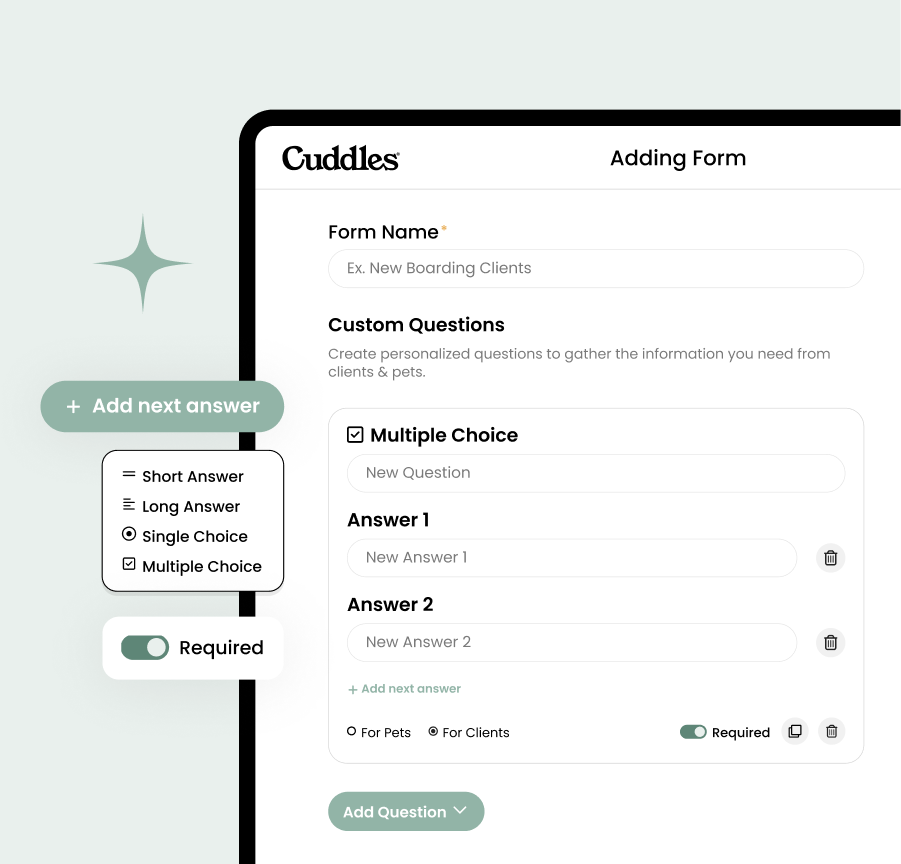
With Cuddle’s custom forms, businesses can create service-specific forms using multiple field types, including short answer, long answer, single choice, multiple choice, and required questions. That is what a strong intake system should allow different services to ask different questions without pushing every client through the same one-size-fits-all form.
A well-designed custom forms workflow improves the quality of the answers you collect. Just as importantly, it increases the chances that your team will actually use that information later because it was gathered in a format that matches the service.
Start Simple, Then Make Your Forms Smarter
Start with one intake form for new client profiles. Include the core client and pet information your team always needs. Then add custom forms for the services that require different intake questions, whether that is grooming, daycare, boarding, or training. Keep only the questions your staff will actually use, and make required fields truly necessary.
That approach usually means less typing, fewer errors, and more accurate profiles, without making intake feel like homework for the client.
If your current intake process still depends on paper forms, copied notes, or staff retyping the same answers into pet profiles, that is the first bottleneck worth fixing. Clean intake gives the rest of your business a stronger starting point.
A good intake form saves time. Good custom forms save time while also improving the quality of the profile you build. That is where the real value is. You get more accurate data, fewer avoidable mistakes, and information that is easier to use when a client’s pet is standing right in front of you and the clock is already ticking.